

Alfred Waterhouse’s influence is woven throughout Reading, with several of his grand Victorian designs still standing as prominent landmarks.
Alfred Waterhouse, the famed architect of the Natural History Museum in London, had a strong connection to Reading. He lived in the town for many years at Foxhill House and left a significant mark on its Victorian landscape.
All photos have been taken by myself and are free to use under the terms of the CC BY-ND 4.0 licence, basically you are free to use the pictures even commercially but you must attribute.
This is very much a work in progress, and I will add more as and when I come to them, so check back.
Waterhouse Buildings Featured on the Map
Here are the buildings and structures designed by Waterhouse in Reading:
Civic & Public Buildings
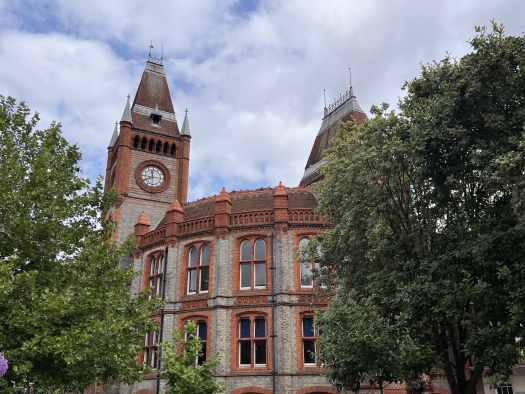
Reading Town Hall (The Waterhouse Wing)*
Designed in 1875, Waterhouse added the iconic facade, the council chamber, and the distinctive clock tower. His work is characterized by the use of red and grey bricks with terracotta ornamentation.
The Rising Sun Institute (now the Rising Sun Arts Centre)
Located on Silver Street, this building was designed in 1877 as a Temperance movement meeting place.

Educational Buildings
NOTE: You cannot get close to either of these buildings without permission from the school but both are visible from surrounding roads.

Reading School (Main Building)
Built between 1865 and 1871 on Erleigh Road. This is a grand Gothic Revival building featuring red brick with blue brick patterns (diapering).
Leighton Park School (Grove House & The Waterhouse Building)
Waterhouse designed Grove House and the “Annexe” (now renamed the Waterhouse Building). As a Quaker himself, he was a natural choice for this Quaker school.

Private Residences (University of Reading Campus)
Many of his residential works are now part of the University of Reading’s Whiteknights Campus:

Foxhill House
This was Waterhouse’s own family home. It is a classic example of his domestic style and currently serves as the University’s School of Law.
East Thorpe House
Built for Alfred Palmer (of the Huntley & Palmers biscuit family), it is now the home of the Museum of English Rural Life (MERL).


Old Whiteknights House
Another of his designs on the Whiteknights estate.
Churches

St Bartholomew’s Church (located on the corner of London Road and St Bartholomew’s Road)
It is particularly significant because Waterhouse actually did very little ecclesiastical work compared to his civic and commercial projects.Historic England notes it as his “first and possibly only large-scale essay in church building.”
Reading School (Chapel)
On the same site as the main school building is the little chapel.

Lost or Demolished Buildings
- Erlegh Park: Built on the Whiteknights estate for a plantation owner, it was demolished in the 1960s to make way for Wessex Hall.
- Wilderness House: Also located on the Whiteknights estate, this was demolished in the 1950s.
*Note: While Waterhouse designed the main facade of the Town Hall, the later extensions (including the Concert Hall and Museum) were designed by Thomas Lainson, who won a design competition after Waterhouse’s proposal was deemed too expensive by the council.
| Building | Location | Current Use |
| Reading Town Hall | Blagrave Street | Museum / Town Hall |
| Rising Sun Institute | Silver Street | Arts Centre |
| St Bartholomew’s | London Road | Parish Church |
| Reading School | Erleigh Road | Secondary School |
| East Thorpe House | Redlands Road | The MERL Museum |
| Foxhill House | Whiteknights Campus | University Law School |
| Whiteknights House | Whiteknights Campus | University Offices |
| Leighton Park School | Shinfield Road | Independent School |